


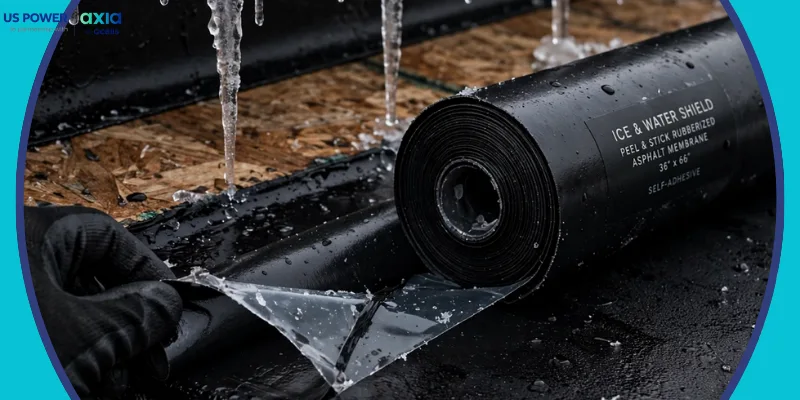
If you’ve ever seen icicles hanging off a gutter while water somehow finds its way into the ceiling below, you’ve watched an ice dam do its damage. Illinois winters produce exactly the conditions that cause it: heavy snow load, hard freezes, and the kind of temperature swings that send meltwater back up under shingles instead of off the roof. Ice and water shield is the membrane roofers install specifically to stop that. It’s a self-adhering waterproof layer that goes down before shingles, in the spots most likely to see standing meltwater. This guide covers what the material actually is, where it belongs on a roof, whether Illinois code requires it, and what it costs to add when you’re already planning a full roof replacement.
What Ice and Water Shield Actually Is
Ice and water shield is a self-adhering membrane, typically a rubberized asphalt or synthetic polymer sheet with a peel-and-stick backing, that bonds directly to roof decking instead of relying on staples or nails alone to hold it in place. That adhesive bond is what makes it different from ordinary underlayment: when a roofing nail passes through it during shingle installation, the membrane seals tightly around the shank instead of leaving an open puncture. Standard felt or synthetic underlayment sheds water moving downhill, but it does nothing to stop water that’s being pushed uphill by an ice dam. Ice and water shield is built to handle exactly that reverse-flow scenario.
What Causes Ice Dams on Illinois Roofs
An ice dam forms when heat escaping from a warm attic melts the underside of the snow layer on the roof, and that meltwater runs down until it reaches the unheated overhang past the exterior wall, where it refreezes into a ridge of ice. Once that ridge builds up, additional meltwater pools behind it instead of draining off the eave, and standing water under enough pressure will find its way under shingles, through nail holes, and into the decking below. Illinois sees this cycle repeatedly through a typical winter, since the state gets both sustained cold snaps and the freeze-thaw swings that keep the dam actively growing rather than melting off in one pass. The root cause usually traces back to attic ventilation and insulation gaps that let too much heat reach the underside of the roof deck in the first place, so ice and water shield is best understood as a backstop for that heat loss, not a fix for it.
Where Ice and Water Shield Gets Installed
Ice and water shield isn’t meant to cover an entire roof deck. It’s installed in the specific zones where water is most likely to be forced backward or trapped.
Eaves and Overhangs
Building codes that require ice and water shield typically call for it to extend from the roof’s lowest edge to a point at least 24 inches inside the exterior wall line, which covers the overhang where ice dams actually form and pushes coverage well past the dam itself for margin.
Valleys and Roof-to-Wall Transitions
Valleys concentrate a huge volume of runoff into a narrow channel, and roof-to-wall transitions create a natural catch point for wind-driven snow and ice, so both get the same self-adhering membrane even on roofs where the eaves are the only code-mandated area.
Around Penetrations and Skylights
Chimneys, vent pipes, and skylights all interrupt the roof deck, and flashing installed poorly around those penetrations is one of the most common places a leak actually starts, so ice and water shield gets wrapped around the base of each one as an extra layer beneath the flashing itself.
Does Illinois Building Code Require It
Most Illinois jurisdictions that have adopted the International Residential Code require an ice barrier in areas with a history of ice forming along the eaves and causing water to back up under the roof covering, which describes most of the state. That code language, found in IRC section R905.1.2, specifically calls for a self-adhering membrane at the eave, not standard felt, in exactly the zone where ice dams form. Because code adoption and enforcement vary by county and municipality, homeowners should confirm the exact requirement with their local building department, but in practice, a properly permitted roof replacement almost anywhere in Illinois is going to include it regardless of whether a homeowner asks. It’s also worth checking for visible signs your Illinois roof already needs replacing if past winters have left water stains or granule loss near the eaves, since that’s often the first evidence of ice dam damage on a roof that was never properly protected.
Ice and Water Shield vs Standard Underlayment
The rest of the roof deck, everywhere outside the eaves, valleys, and penetrations, still needs an underlayment layer beneath the shingles, and that’s where felt or synthetic sheet underlayment takes over. Standard underlayment is mechanically fastened rather than adhered, sheds water efficiently in normal downhill flow, and costs meaningfully less per square than a self-adhering membrane. Using ice and water shield across an entire roof deck would work, but it’s rarely worth the added material cost for the parts of the roof that never see standing or reversed water flow. A well-built cold-climate roof system uses each material where its properties actually matter: the adhesive, nail-sealing membrane at the vulnerable edges and transitions, and the cheaper mechanically fastened underlayment everywhere else.
What Happens When a Roof Skips It
A roof without ice and water shield in a cold Illinois winter isn’t guaranteed to leak every year, but it’s exposed every time conditions line up for a dam to form. Water that backs up under shingles at an unprotected eave soaks into the decking, and repeated freeze-thaw cycles on wet decking accelerate rot and weaken the nail-holding capacity of the wood over time. From there, water tracks into attic insulation, reducing its effectiveness right when the home needs it most, and eventually shows up as staining or active dripping on interior ceilings near exterior walls. None of that damage is visible from the ground, which is why it often goes unnoticed until a homeowner is dealing with a soft spot in the decking or a mold problem that traces back years to a single unprotected eave.
How to Confirm Your Contractor Installs It Correctly
Because ice and water shield goes down before the shingles, it’s one of the easiest components for a rushed or corner-cutting crew to skip or under-install without a homeowner ever seeing it happen. US Power Roofing installs a code-compliant ice barrier as a standard part of every cold-climate roof replacement, not as an upsell, and documents the coverage with photos taken before shingles go on. If you’re vetting a contractor for an Illinois project, ask specifically whether ice and water shield is included in the base bid or listed as an add-on, and walk through a full new roof installation checklist so you know what to expect at each stage, not just the finished shingles on top.
Cost and Value of Adding Ice and Water Shield
Ice and water shield costs more per square than standard underlayment, but because it only covers specific zones rather than the whole roof deck, the total added cost on a typical residential re-roof is a small fraction of the overall project. Professional solar panel cleaning and maintenance can also help keep rooftop solar equipment performing properly once the roofing work is complete. Compared against what a full roof replacement runs in Illinois, the incremental cost of proper ice barrier coverage is minor next to the cost of repairing rotted decking, replacing soaked insulation, or fixing a water-damaged ceiling after a dam-related leak. For a material that’s largely invisible once the roof is finished, it delivers an outsized amount of protection against the specific failure mode that Illinois winters are most likely to cause.
Protecting an Illinois Roof Before the Next Freeze
Ice and water shield isn’t a luxury upgrade or a sales add-on. In a climate that produces repeated freeze-thaw cycles every winter, it’s a targeted, code-aligned defense against the single most common cause of cold-weather roof leaks. The material itself is inexpensive relative to the rest of a roofing project, and the real variable is whether it gets installed correctly, at full coverage, by a crew that treats it as standard practice rather than an afterthought. Homeowners planning a roof replacement in Illinois should confirm ice and water shield is already built into their quote, and if it isn’t, that’s worth asking about before signing anything. If you’re also considering solar for your home, explore your solar options while planning the roof work. You can find a roofing contractor you can trust or reach out to US Power Roofing directly to talk through what your specific roof needs before the next freeze.
Frequently Asked Questions
Does every roof need ice and water shield?
Every roof in a climate that sees freeze-thaw cycles benefits from it at the eaves, valleys, and penetrations, though the exact code requirement depends on local jurisdiction. Roofs in consistently warm climates without a history of ice damming generally don’t need it.
How much does ice and water shield add to a roof replacement?
Because it only covers specific vulnerable zones rather than the entire roof deck, it typically adds a small percentage to the total project cost, far less than what full-deck coverage with the same material would cost.
Can ice and water shield be installed over an existing roof deck without a full tear-off?
It needs to bond directly to clean, dry decking to seal properly, so it’s installed during a full roof replacement or a deck-level repair rather than layered over old shingles or a worn deck.
Does ice and water shield expire or wear out over time?
The membrane is designed to last as long as the roofing system above it once it’s properly installed and covered, since it isn’t exposed to direct sunlight or weather after the shingles go on.
Is ice and water shield the same thing as ice dam prevention?
No. Ice and water shield manages the water an ice dam produces so it can’t reach the decking, but it doesn’t stop the dam from forming in the first place. Preventing the dam itself comes down to attic insulation and ventilation.
See our roofing services in Illinois.


